There is a difference between a daydream and an act of faith. When God births something in a person through time spent renewing the mind in His word, and that person applies the imagination to it, this is not wishful thinking or a desire of the flesh. It is faith. It lines up with what God has already said, and heaven answers it. The worlds were formed in Christ before they were formed in time; they existed in Him first, long before the foundations of the earth were laid.
I tested this in my own life. I spent time meditating on what I believed God had shown me, matched it with corresponding natural action, gave toward it, and kept returning my thoughts to it, day after day, instead of letting it fade after the first excitement wore off. What happened was not excitement or hype. It was peace. Joy came over me, the kind that settles rather than spikes, because the Word of God was running the process rather than my own appetite or ambition.
That distinction is everything. The world counterfeits this same mechanism for entirely selfish ends, and because the Word of God has no part in it, the result is empty. Scripture calls that a vain imagination, and I point to Genesis 11 as the pattern: Humanity gathered in one mind and built a tower meant to reach heaven on its own terms, apart from God. This generation’s culture manufactures vain imaginations the same way, every day, at scale, through every screen people carry.
Against that is a sober imagination, a mind renewed to the Word of God. Sober does not mean joyless rule-keeping. When the Word of God is flowing, a believer can walk in joy unspeakable and full of glory, with pleasures that do not run dry in the presence of God Almighty, the way light reveals more light to anyone standing in it (see Psalm 36:9 and 1 Peter 1:8 KJV). Once the imagination itself is purified by the Word, it can be engaged freely and without strain, because God is in it rather than against it.
When I imagined God’s desired plan for my life according to the Word of God, it felt a bit strange at first. I had to give myself permission to act like what I believed was already true. I was speaking to my wife and my team as though a vision not visible in the natural was already in motion. It almost felt intellectually dishonest at the start, like I was pretending, and I had to push past that discomfort.
I kept walking through it in my imagination, picturing the people involved and the outcome, until something I had thought impossible actually came within reach. The Lord, by favor I could not manufacture myself, made a way to do it. Following that, prophetic words I had not gone looking for were confirmed. I could watch them land exactly when I had been told they would. This was only the first small preview of a larger picture, not the whole promise arriving at once, and the moment it began to move, real resistance showed up to try to stop it. I had to fight for God’s promises down to the last minute, and still they came through.
And do not be conformed to this world, but be transformed by the renewing of your mind, that you may prove what is that good and acceptable and perfect will of God.
—Romans 12:2
Scripture frames the renewing of the mind directly. Culture is not simply competing for attention; it is actively trying to hijack the mind a believer needs for faith to function. A tower built to reach heaven on human terms is not much different than a social media feed scrolled for hours on human terms. They come from the same root, even though one looks ancient and the other looks like entertainment. Both occupy the imagination with something other than the Word of God, and whatever occupies the imagination is what eventually gets built, prayed for, or given up on.
A Test Case In Giving
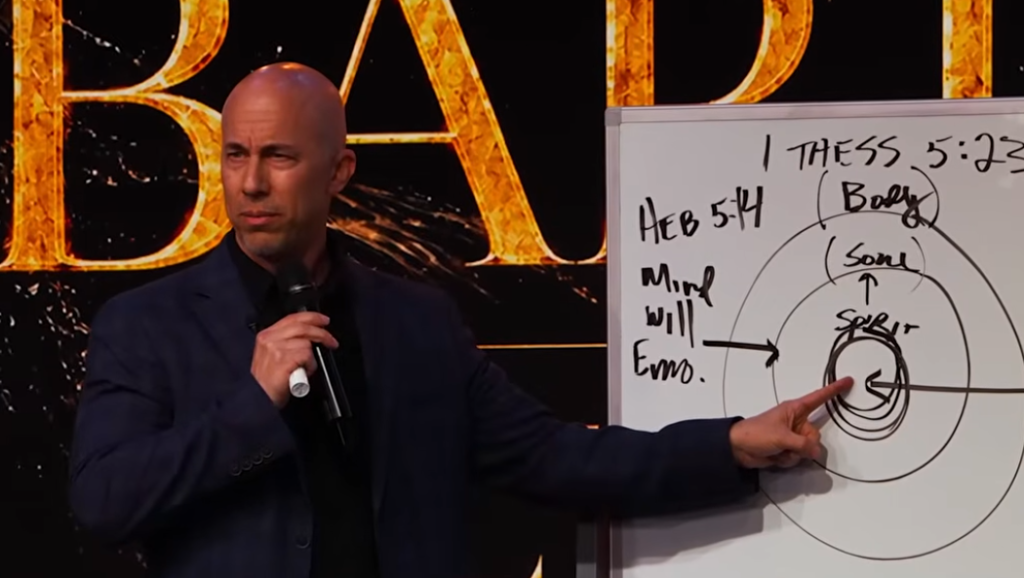
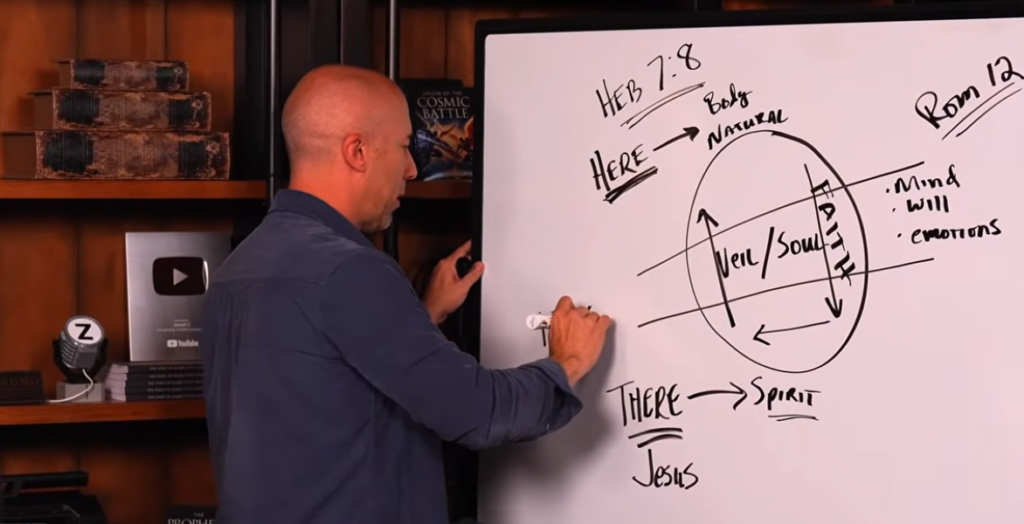
There is a relationship between the natural world and the realm of the Spirit. The natural is where people live out their days in their bodies. The realm of the Spirit is where God is (see John 4:24). Between the natural and the realm of the Spirit is the soul: the mind, will, and emotions. Everything a person does in the natural passes through the soul before it becomes anything spiritual at all. It works this way with tithing as well.
Here mortal men receive tithes, but there he receives them, of whom it is witnessed that he lives.
—Hebrews 7:8
In the natural, a person drops an offering into a bucket. In the Spirit, Jesus receives it. An action taken here becomes what Jesus receives there, which produces a reaction that breaks back into the natural as a miraculous response. This pattern is not limited to giving. The same mechanism works for healing, depression, destiny, and anything a believer brings before God in faith rather than in formula.
The stronger version of this happens specifically in the space of imagination. Meditating on whatever is pure, just, and of good report is important so that the mind thinks the Word, the will conforms to the Word, and the emotions submit to the Word. When your soul is submitted to God’s Word, it will open what I picture as a valve between the natural and the Spirit.
Finally, brethren, whatever things are true, whatever things are noble, whatever things are just, whatever things are pure, whatever things are lovely, whatever things are of good report, if there is any virtue and if there is anything praiseworthy—meditate on these things.
—Philippians 4:8
What is already finished in the Spirit begins to move into the natural once a believer’s imagination lines up with it. That is the difference between dreaming a dream that is anchored in the Word of God and simply wanting something to be true. One is faith reaching for what has already been settled; the other is wishing against the odds.
This is a stronger application, because it does not stop at a single transaction the way an offering does. An offering is one action met with one reaction. An imagination saturated with the Word keeps producing that same cycle continually, drawing out of the Spirit whatever has already been laid up there, because the valve stays open rather than opening and closing once. It is the difference between a single spark and a current that keeps running as long as the mind stays renewed.
Abraham, Sarah, and The Stars
A clear example of this is in Genesis 15 with Abraham and Sarah. Abraham was eighty-five years old, and Sarah was seventy-seven. At that age, the promise of a child did not match anything either of them could see in the natural. I imagine their likely reaction to one another was Sarah doubting that Abraham would father a child at that age, Abraham doubting that Sarah could carry one at hers. The natural evidence argued against the promise from both directions at once. Instead of pointing Abraham back toward Sarah, the Lord pointed him somewhere else entirely.
Then He brought him outside and said, “Look now toward heaven, and count the stars if you are able to number them.” And He said to him, “So shall your descendants be.” 6And he believed in the LORD, and He accounted it to him for righteousness.
—Genesis 15:5-6
Abraham was told to look at the sand and the stars, not at Sarah and not at his own age. The Word of God had already been spoken over him. What he needed was not new information but his imagination, faith, and his mind, will, and emotions brought into agreement with what had already been said. I picture the Lord repeating the instruction on purpose, almost redirecting Abraham’s gaze a second time, because the natural pull back toward Sarah and toward the calendar would have been constant. Looking at the sand and the stars instead of looking at the circumstance itself was the act of faith. The promise did not change, but where Abraham fixed his imagination did.
Abraham did not stay perfectly in that place. He eventually tried to help the promise along on his own terms through Ishmael, and the result was a detour he had not been asked to make. The lesson here is not that Abraham failed outright, but that trading the dream God actually gave for a smaller, more manageable version of it is always the worse deal. However, at the time, it looked reasonable. The promise still arrived; it simply arrived with more detour than it needed to have.
Guard What You Feed Your Mind
Believer’s faith is directly connected to what they focus their attention on. Scrolling for hours puts whatever is on the screen into the mind for that entire stretch of time, and that becomes the only material shaping the imagination during it. This is not fundamentally a question of sin. Watching a show or listening to music is not wrong in itself. However, if it is filling the hours that should be renewing the mind in the Word, it is hijacking the imagination all the same, whether or not anyone involved intends it that way.
The test I offer is not a content rating but a purpose. Social media that is used to advance the kingdom, feed on the Word, and further the gospel is a tool worth keeping. If it’s used only as filler, it becomes a disadvantage, regardless of how harmless any single piece of it looks on its own. Staying clear-eyed and clear-minded means paying attention to what is actually going into the imagination through every screen, song, and show, because that is the raw material the imagination will eventually work with, for good or for nothing.
This is especially true given how constant the input has become. Scrolling past the same handful of platforms for hours does not feel like a decision in the moment; it feels like nothing at all, which is exactly why I call it a hijacking rather than a choice. A believer rarely sits down and decides to stop renewing the mind in the Word. The hours simply go somewhere else, a little at a time, until the imagination has been shaped by whatever filled it without anyone noticing it happen.
There’s a vision I am still walking out, and still letting God adjust as it unfolds. It’s being carried forward by meditating on it, speaking as though it were already true, and acting on it rather than rehearsing every reason it might not happen. Part of what I am picturing involves reaching people who have almost no other access to the gospel. The ministry is reaching twenty-three thousand people inside the prison system through media. That is only the introduction to what I believe is coming next, not the finished picture.
My encouragement is not to manufacture positive thinking but to let the Word of God be the thing the imagination is actually fed on, so that whatever a believer pictures is standing on what God has already said rather than on wishful thinking dressed up to look like faith. A mind renewed in the Word, and given truth to dwell on is much better than whatever happens to be the next scroll. Using your imagination this way is how you imagine reality correctly, the way God already sees it.
The main difference between a vain imagination and a sanctified one is that one borrows the culture’s material and calls the result a dream. The other uses the Word of God and what it produces rather than operating in escapism. It is activating faith that works the way it was always meant to work, patiently, in agreement with heaven, until the natural world catches up to what has already been settled in the Spirit. That is the imagination I want to keep sanctified, the one worth guarding as carefully as it is worth building on.
Don’t let society hijack your imagination; focus on the Word of God and stay in tune with Him. If God is for you, who can be against you (see Romans 8:31)? Jesus is Lord, and on a bad day, you’re anointed to be the very best there is!
For Jesus,
Joseph Z
Click here to watch the full video.