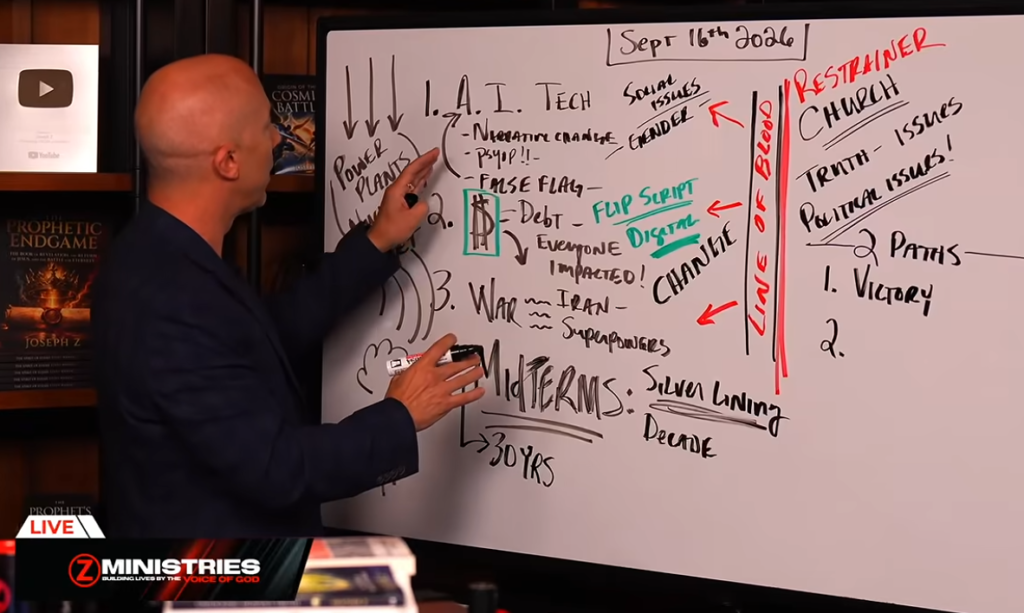
Most believers carry a common picture of the second coming: Jesus splits the sky, descends with the clouds, and the whole world sees Him at once. That picture is not wrong as far as it goes. The angel at the ascension told the disciples plainly that Jesus would return the same way He left, ascending into the clouds until they could no longer see Him, and Scripture is equally direct that His arrival will not stay hidden from anyone.
Behold, He is coming with clouds, and every eye will see Him, even they who pierced Him. And all the tribes of the earth will mourn because of Him. Even so, Amen.
—Revelation 1:7
Jude 1:14 adds a detail worth holding onto: When Jesus comes, He comes with tens of thousands of His saints already with Him. That is a moment of rejoicing for everyone who held on through the tribulation, and a moment of sheer disbelief for everyone who had sworn allegiance to the Antichrist and never saw this coming.
Robes Dipped in Blood
What very few people notice is a detail Scripture gives about the moment just before that return reaches its destination. By the time Jesus actually arrives at the battle of Armageddon, His robes are already covered in blood, and Scripture is specific that the blood is not His own. Something happens before the battle most readers assume opens the whole scene, and that gap is where I want to spend this teaching. There is a narrative out of Isaiah 63 that shows exactly what fills that gap, and it is worth reading slowly.
Who is this who comes from Edom, with dyed garments from Bozrah, this One who is glorious in His apparel, traveling in the greatness of His strength?—“I who speak in righteousness, mighty to save.” 2Why is Your apparel red, and Your garments like one who treads in the winepress? 3I have trodden the winepress alone, and from the peoples no one was with Me. For I have trodden them in My anger, and trampled them in My fury; their blood is sprinkled upon My garments, and all My robes are stained. 4For the day of vengeance is in My heart, and the year of My redeemed has come. 5I looked, but there was no one to help, and I wondered that there was no one to uphold; therefore My own arm brought salvation for Me; and My own fury, it sustained Me. 6I have trodden down the peoples in My anger, made them drunk in My fury, and brought down their strength to the earth.
—Isaiah 63:1-6
The figure identifies Himself as the One “who speaks in righteousness, mighty to save.” I believe this is Jesus Himself. The staining comes from blood that is not His, and the passage is emphatic that no one assisted Him in it. He acted alone, by His own arm, sustained only by His own fury against what had been done to His people.
Note in Luke 4:18-19 Jesus reads Scripture from Isaiah 61:1-2, but He stops before completing verse two. He did not read “And the day of vengeance of our God.”
“The Spirit of the Lord God is upon Me, because the Lord has anointed Me to preach good tidings to the poor; He has sent Me to heal the brokenhearted, to proclaim liberty to the captives, and the opening of the prison to those who are bound; 2 To proclaim the acceptable year of the Lord, ‘And the day of vengeance of our God.’”
—Isaiah 61:1-2
The “day of vengeance” mentioned in the last half of Isaiah 61:2 was still future then, and I believe the passage in Isaiah 63 is where it finally arrives. Isaiah 63 reads like Jesus is the Avenger of Blood. The sentence He left unfinished in Luke 4 finally closes here, in a scene most readers never connect back to it.
I am careful to separate this from any claim that the Church is appointed to suffer God’s own wrath. Believers living under the Age of Grace are not the target of what Isaiah 63 describes; the Age of Grace ends with the Church caught up before the full force of this judgment falls. What the passage shows instead is what is reserved for those who have aligned themselves against the people God is defending. Knowing this removes a layer of fear from the passage rather than adding one, even with how violent the imagery is.
Scripture also tells us what happens on the other side of that battle. The beast and the false prophet are not simply struck down and left where they fall; they are captured and held under judgment. I do not know whether that captivity runs for a day or for months while the nations watch, because the text does not say how long. What it does say is where they end up: not in a holding cell and not even in hell, the way people usually picture it. Instead, the lake of fire, the second death, the same final judgment reserved for everyone who never turned to Him.
A Detour on the Way Up
After the resurrection, Scripture describes Jesus making an open display of the powers of darkness with language I connect to Colossians, where the cross itself disarms rulers and authorities and puts them on open display (see Colossians 2:15). I believe Jesus also went to the place where the spirits in prison were held and dealt with them before rising.
I connect this descent to Psalm 22, where the psalmist describes being surrounded by hostile strength, “the bulls of Bashan,” closing in with mouths gaping open (see Psalm 22:12-13). I picture Jesus confronting that same hostile company directly, for a set span of time, before the ascension that follows ever begins. From there, Psalm 24 shifts the posture entirely, from siege to triumphant return, with angels at heaven’s gates calling out to whoever approaches.
Lift up your heads, O you gates! And be lifted up, you everlasting doors! And the King of glory shall come in. 8Who is this King of glory? The LORD strong and mighty, the LORD mighty in battle. 9Lift up your heads, O you gates! Lift up, you everlasting doors! And the King of glory shall come in. 10Who is this King of glory? The LORD of hosts, He is the King of glory.
—Psalm 24:7-10
I picture this as a procession, angels already with Jesus answering back to the angels stationed at the gates, the kind of moment that calls for real celebration rather than solemnity. However, in the middle of that ascent, something interrupts it. Jesus does not go straight from the empty tomb to the Father. He stops in a garden where a grieving woman named Mary is searching for a body she cannot find, mistaking Him at first for the gardener.
But Mary stood outside by the tomb weeping, and as she wept she stooped down and looked into the tomb. 12 And she saw two angels in white sitting, one at the head and the other at the feet, where the body of Jesus had lain. 13 Then they said to her, “Woman, why are you weeping?” She said to them, “Because they have taken away my Lord, and I do not know where they have laid Him.” 14 Now when she had said this, she turned around and saw Jesus standing there, and did not know that it was Jesus. 15 Jesus said to her, “Woman, why are you weeping? Whom are you seeking?” She, supposing Him to be the gardener, said to Him, “Sir, if You have carried Him away, tell me where You have laid Him, and I will take Him away.” 16Jesus said to her, ‘Mary!’ She turned and said to Him, ‘Rabboni!’ (which is to say, Teacher). 17Jesus said to her, ‘Do not cling to Me, for I have not yet ascended to My Father; but go to My brethren and say to them, “I am ascending to My Father and your Father, and to My God and your God.”’
—John 20:11-17
My point here is narrow but deliberate: The ascension itself paused for one person’s longing. Mary’s desire to be near Him placed a demand on that moment that altered the sequence, even briefly. Notice that Jesus says, “Do not cling to Me, for I have not yet ascended to My Father.” I am careful not to claim this changes prophecy or moves the timeline God the Father has already fixed. However, it shows something true about how God interacts with longing and desire within whatever He has already determined, and that pattern is what I believe happens on the way back down.
However, it shows something true about how God interacts with longing and desire within whatever He has already determined. I believe this pattern will repeat when Jesus comes back.
I think about this alongside Matthew 24:20, where Jesus tells His disciples to pray that the hardest days do not fall in winter or on a Sabbath. That instruction only makes sense if prayer can shape something real about how those days unfold. I am not saying our longing moves the date of His return; only the Father knows that. I am saying our watching, our eager desire for Him, our prayers while we wait, can shape details inside a timeline He has already fixed, the same way Mary’s grief shaped one morning in a garden two thousand years ago.
A Detour on the Way Back
If the ascension bent once for Mary’s longing, could the return bend once more, this time for believers who are not yet rescued when Jesus starts His descent toward Armageddon with the saints behind Him? Many students of this passage connect it to a specific location, a possible holdout for believers during the tribulation, often identified with Petra. My proposal is that Jesus, already moving toward the final battle with tens of thousands of His own behind Him, hears their cries along the way and will not leave them to be overrun while He finishes the larger confrontation elsewhere.
I picture it almost like a king who cannot be everywhere in the same instant: The main engagement is still Armageddon, where the beast, the false prophet, and the armies gathered against Jerusalem are waiting, fully committed to the mark of the beast as an act of worship and allegiance rather than anything taken by accident. But a smaller, desperate group, pressed on every side and out of options, simply cannot wait their turn. I believe Jesus treats that cry as urgent enough to interrupt His own march, the same way He once stepped out of His ascension for one woman weeping in a garden.
So instead of continuing straight to Armageddon, I believe Jesus turns aside first, alone, exactly as Isaiah 63 describes, and deals with the enemies pressing those believers Himself, by His own arm and His own fury, with no one beside Him to share the work. That is why I read the staining itself so literally: defeating an armed company by hand leaves exactly the kind of mark Isaiah describes, blood genuinely sprinkled across the garments rather than a figure of speech. Only after that stop does He arrive at Armageddon already covered in blood that is not His, meet the beast and the false prophet, and end the conflict decisively, sending them to final judgment rather than any extended confinement.
A delay would not be gentle here. If Jesus pressed on to Armageddon first and circled back for the believers at Petra afterward, there might be no one left to rescue by the time He arrived. The detour only works because it happens on the way, before the siege finishes what it is trying to do, which is exactly why I think Isaiah 63 places the blood on His robes before Armageddon rather than after it.
I anticipate the objection that this reading makes Jesus sound harsh, and I want to meet it directly rather than soften it. Real love always carries a corresponding hatred of whatever threatens the one being loved; a parent who would do anything to stop harm from reaching a child is not failing to love gently, but loving completely. The wrath described in Isaiah 63 is not a contradiction of the gentleness believers rightly associate with this Age of Grace. It is what that same love looks like once the cup of patience Scripture describes has finally been poured out in full, and the people it was protecting are no longer left waiting for rescue.
None of this can be proven down to the exact location or the hour, and I am not going to argue past that limit. The timing and placement of this detour are my own reading of Isaiah 63 alongside Psalm 24 and John 20, not a line Scripture states outright in so many words, and other serious readers land elsewhere on the same text. What I am confident about is the pattern underneath it: The end itself, the return, the judgment, the millennial reign that follows, is settled, and only the Father knows the hour. Whether God adjusts the smaller details of how that day unfolds in response to His people’s cries is a different question, and the Mary account at least shows it is not off the table.
The detail in Isaiah 63 is not a footnote to the second coming; it is a window into how personally Jesus treats the people still holding on when He returns. A king arriving to settle a battle might reasonably go straight to the battlefield. I believe Scripture describes a King who makes a stop first, because the people calling out to Him matter enough to interrupt even His own march to Armageddon.
That is the real comfort underneath a passage that reads as violent on its surface. The wrath belongs to the enemies who pressed God’s people to the edge of being wiped out. The rescue belongs to the ones who were crying out and had nowhere else left to turn. My point in walking through Isaiah 63 is not to frighten you with the blood on the robe, but to show what it costs Jesus to get a desperate, surrounded people safely to the other side of it.
For Jesus,
Joseph Z
Click here to watch the full video.