Angels of Fire
For our God is a consuming fire.
—Hebrews 12:29
Angels were created directly out of God’s own essence, drawn from consuming fire, forged by His word, and operating as autonomous extensions of it. Angels are fiery servants of God. Scripture also calls angels winds, and wind carries the same association with God’s breath and His voice.
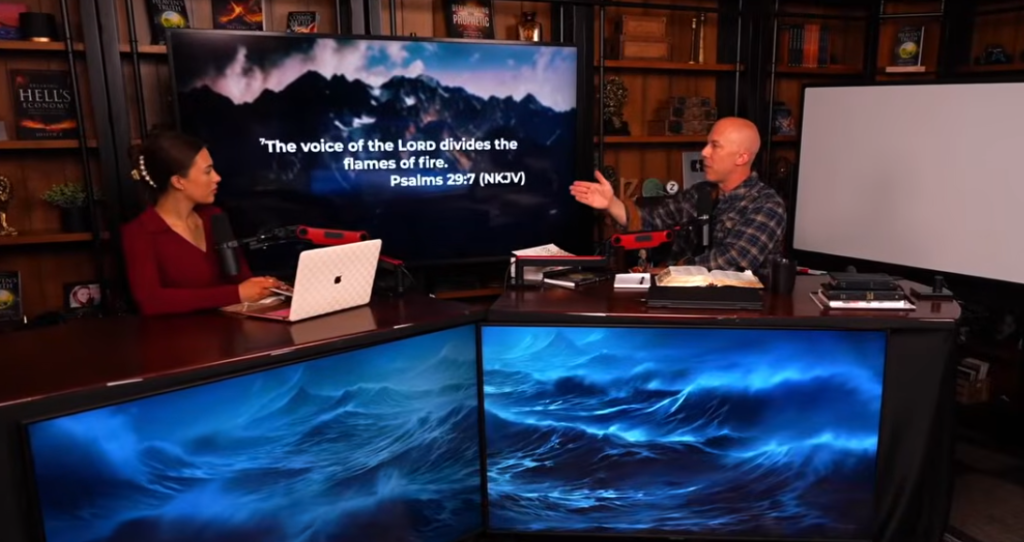
The voice of the LORD divides the flames of fire.
—Psalm 29:7
When God speaks, He “divides the flames of fire,” which means He commands them, releases them on assignment, and puts them into rank and file. Angels have their own will, but being born directly out of the fire of God, their purpose is to do what they were built for. It was a betrayal of that very purpose when a portion of them joined Lucifer’s mutiny against Him.
The Voice of God is the written Word of God, so when someone speaks a promise from Scripture, angels must respond because they are hearing the Voice of God rather than a human voice. It is important to understand that prayers that activate angels are built out of Scripture and spoken aloud. They use the authority of Scripture to push back principalities, fallen angels, and other demonic forces.
Angels are also described as highly intelligent spirit beings never destined to be united with a human body. Unlike people, they carry no human soul, yet they live out an immortal existence simply because they were never given a physical body. They exist as God’s companions in the courts of heaven, which is what makes the mutiny of a portion of them such a betrayal of their God-given purpose.
The Authority Adam Gave Away
There was a celestial battle in eternity past, and the devil was cast out of heaven. He comes to accuse people day and night; however, Jesus described the ruler of this world as already judged and cast out (see John 16:11). Once Jesus sat down at the right hand of the Father, He took up permanent intercession for believers (see Romans 8:34). Any accusation the devil brings now runs into that intercession first.
In the book of Job, the devil already had access to God’s presence on the earth. How? The answer traces back to Eden. The serpent deceived Adam and Eve, and in complying, Adam gave his God-given authority for dominion over the earth to Satan. From that point on, the devil could move anywhere he wanted because he carried Adam’s standing rather than his own. That is also why, when the devil later offered Jesus the kingdoms of the earth in the wilderness (see Matthew 4:8-9), Jesus never told him he was lying. He wasn’t—Adam had surrendered it to Satan.
Now there was a day when the sons of God came to present themselves before the Lord, and Satan also came among them. 7 And the Lord said to Satan, “From where do you come?” So Satan answered the Lord and said, “From going to and fro on the earth, and from walking back and forth on it.” 8 Then the Lord said to Satan, “Have you considered My servant Job, that there is none like him on the earth, a blameless and upright man, one who fears God and shuns evil?” 9 So Satan answered the Lord and said, “Does Job fear God for nothing? 10 Have You not made a hedge around him, around his household, and around all that he has on every side? You have blessed the work of his hands, and his possessions have increased in the land. 11 But now, stretch out Your hand and touch all that he has, and he will surely curse You to Your face!” 12 And the Lord said to Satan, “Behold, all that he has is in your power; only do not lay a hand on his person.” So Satan went out from the presence of the Lord.
—Job 1:6-12
The word “behold” is the turning point. It doesn’t portray a decision handed down; instead, I believe the devil realized in that moment exactly how much authority he was actually holding. He had authority that came from Adam rather than from God directly. Job had none of the covenant promises that New Testament believers carry. Everything changed at the cross: Jesus, as the last Adam, did not come only to redeem people. He came to take back the dominion the first Adam gave away.
People sometimes describe a hard season as “a Job trial.” Under the New Testament, the comparison only goes so far. Job faced his trial with three friends offering conflicting, unhelpful counsel and no covenant promises to stand on; he simply held to the fact that God existed and stayed loyal without understanding why. Later, when the devil asked to sift Peter like wheat, Jesus had already prayed for him (see Luke 22:31-32), and that same intercession now stands for every believer seated in the New Testament rather than the Old. Job also came through his trial with everything multiplied back to him, and the promise reaches further still for anyone standing under the new covenant.
How the Devil Talks
Job chapter four has a passage with valuable insight, although it is rarely taught. Eliphaz, one of the three friends offering Job bad counsel, describes a supernatural encounter of his own.
Now a word was secretly brought to me, and my ear received a whisper of it. 13In disquieting thoughts from the visions of the night, when deep sleep falls on men, 14fear came upon me, and trembling, which made all my bones shake. 15Then a spirit passed before my face; the hair on my body stood up. 16It stood still, but I could not discern its appearance. A form was before my eyes; there was silence; then I heard a voice saying: 17 “Can a mortal be more righteous than God? Can a man be more pure than his Maker? 18If He puts no trust in His servants, if He charges His angels with error, 19how much more those who dwell in houses of clay, whose foundation is in the dust, who are crushed before a moth? 20They are broken in pieces from morning till evening; they perish forever, with no one regarding. 21Does not their own excellence go away? They die, even without wisdom.”
—Job 4:12-21
In roughly the same period, the devil had been granted access to Job; Eliphaz, “In disquieting thoughts from the visions of the night, …” overhears the devil talking to himself. His complaint holds God in contempt for trusting anything to people. He calls people, “…those who dwell in houses of clay, whose foundation is in the dust, who are crushed before a moth…” which exposes the devil’s native tongue: murmuring, complaining, accusation, and self-pity dressed up as an argument. Luciferianism grows directly out of that posture—a victim mentality that casts God as the villain.
That same tone is why Scripture treats gossip, slander, and discord among believers so seriously. The spirit of accusation deactivates angels and puts a person in agreement with darkness. Self-righteousness ranks among the most serious sins there are, since the only real standing anyone has comes from the blood of Jesus rather than personal performance.
There is also a line between being correct and being right. The enemy often works through pure logic. He uses reasoning that holds together on its own terms but still misses the leading of the Spirit and the Word of God. It is wisdom, not raw knowledge, that keeps someone from reaching for what can cause harm to them. The same imbalance plays out across the culture among people always learning but never arriving at the knowledge of truth, holding a form of godliness while denying its power (see 2 Timothy 3:5, 7).
Wisdom, however, is available for anyone who asks. If you lack wisdom, ask God, who gives generously as long as you ask out of faith rather than doubt (see James 1:5-8). Doubt leaves a person like someone who glances in a mirror and forgets what he saw the moment he looks away (see James 1:23-24). Staying in the Word long enough is what changes the reflection, carrying a person from grace to grace and into the image of Christ (see 2 Corinthians 3:18).
Where the Veil Grows Thin
Many people have wondered how angels are ranked or organized in dominion and authority. These two passages describe layers of celestial authority.
Far above all principality and power and might and dominion, and every name that is named, not only in this age but also in that which is to come.
—Ephesians 1:21
For by Him all things were created that are in heaven and that are on earth, visible and invisible, whether thrones or dominions or principalities or powers. All things were created through Him and for Him.
—Colossians 1:16
The theologian Dionysius, writing around A.D. 500, arranged angelic beings into three hierarchies of three choirs each: seraphim, cherubim, and thrones; dominions, virtues, and powers; principalities, archangels, and angels. He concluded that only the last two choirs, archangels and angels, carry a direct mission to people, while the higher ranks are tied to broader, territorial assignments.
The angels most people interact with are very likely drawn from those two lower choirs, archangels and angels, the ones built specifically to serve humanity, while beings of a higher substance operate at a different level entirely. It doesn’t matter what rank they are; the name of Jesus and the blood of the Lamb outrank every one of them.
It is important to know the way they operate and the role they play in the strange lights and signs that are marketed, predicted, and programmed into the culture. The subject of angels goes along with another recurring one, the demonic side of the same unseen realm, and both connect to a pattern the Bible describes in the days of Noah.
That hierarchy connects to what people describe they see in the skies now—strange lights, unexplained craft, creatures nobody can quite name. The phenomenon sorts into three possibilities: technology not yet understood, staged events, or genuine demonic activity. Eliphaz supplies the model for that third category. He felt a spirit pass in front of him, watched the hair on his body stand up, and still could not fully make out what he was looking at while it stood directly before him.
Many of today’s half-seen encounters read the same way, echoing Jesus’ own words that the days before His return would look like the days of Noah (see Matthew 24:37-39). Those days would be ordinary on the surface while something genuinely unusual moves underneath. Call it a thinning of the veil between the natural world and what stands behind it, on both the light side and the dark side of that boundary. That comparison points to the last days rather than a claim about the end times themselves. The last days feel ordinary on the surface while the veil in front of both realms keeps thinning. This is why it is important to stay planted in the Word of God rather than reactive to every strange headline or sighting.
The New Testament version of all this is simpler. Angels are ministering spirits, sent out to serve the heirs of salvation (see Hebrews 1:14). God does not direct His help to angels directly; He directs it to the seed of Abraham, to Jesus (see Hebrews 2:16), and everyone in Christ shares in that help. When we speak the Word of God, angels move on it. Now, in the last days, we are equipped to overcome by the blood of the Lamb and the word of our testimony (see Revelation 12:11).
Jesus is Lord, and even on a bad day, you are anointed to be the very best there is.
For Jesus,
Joseph Z
Click here to watch the full video.