The Spirit Behind the Culture
Scripture describes a contrast between the Spirit of God at work in believers and the spirit already active in the world.
You are of God, little children, and have overcome them, because He who is in you is greater than he who is in the world.
—1 John 4:4
1 John 4:4 names two forces. Christ dwells in the believer, but the world operates under a different influence, the one Scripture identifies as “he who is in the world”; the spirit of the Antichrist himself, the man of sin. He may not yet be present on the earth, or he may be hidden until his appointed hour. What is unmistakably present is his spirit: a lawless spirit that refuses authority, operates in rebellion, and pushes back against every structure a nation or a church was built on.
This is not a new development. The spirit of rebellion traces back to Nimrod, the leader in the valley of Shinar who built the Tower of Babel, and Scripture says that he became a mighty man (see Genesis 10:8-9; 11:1-9). He set himself up as a figure of authority ruling from a tower, and history has repeated that pattern in every generation since.
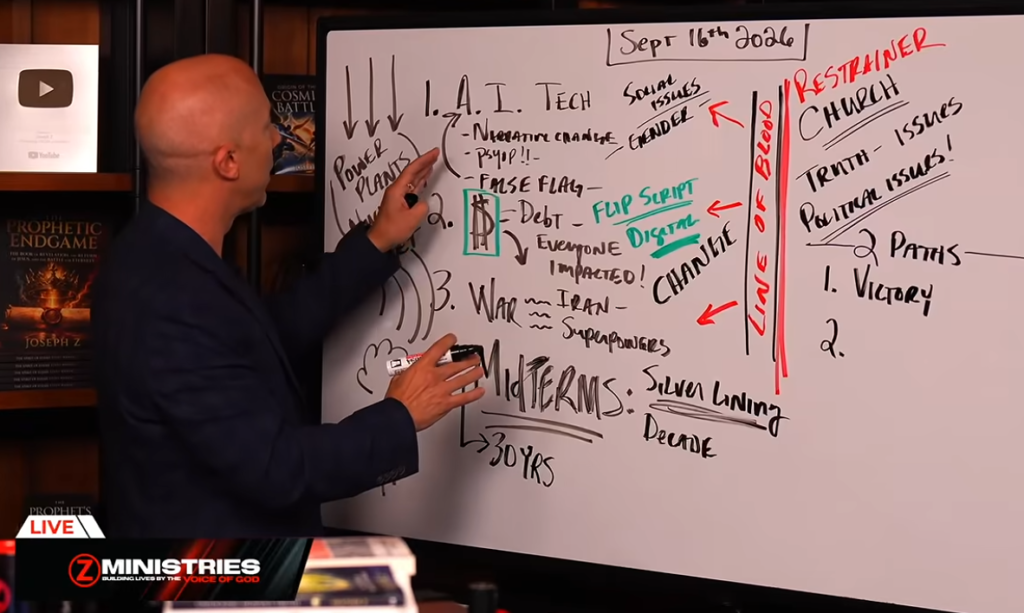
Ephesians speaks of the fullness of time and the dispensations God has ordained (see Ephesians 1:10). Each new epoch brings its own version of the same structure. In the present age, the parallel most often named is technology: artificial intelligence and global research platforms built to concentrate power and knowledge the way Babel once tried to concentrate humanity under one tower. The spirit behind it has not changed. Only the tower has.
If this spirit is left unchecked, it produces people who function like the system around them without ever questioning it, absorbing a culture that broadcasts a narrative around the clock through media and technology built for exactly that purpose.
The remedy Scripture points to is not louder resistance but knowing the Word of God well enough that it does not matter who is talking or what narrative is circulating, because conviction has already been settled from within. That kind of grounding does not develop overnight; it comes from sustained time in Scripture rather than a single decision made under pressure.
Discerning the Signs of the Times
The Pharisees and Sadducees once came to Jesus demanding a sign from heaven. Matthew records the exchange.
Then the Pharisees and Sadducees came, and testing Him asked that He would show them a sign from heaven. 2He answered and said to them, “When it is evening you say, ‘It will be fair weather, for the sky is red’; 3and in the morning, ‘It will be foul weather today, for the sky is red and threatening.’ Hypocrites! You know how to discern the face of the sky, but you cannot discern the signs of the times. 4A wicked and adulterous generation seeks after a sign, and no sign shall be given to it except the sign of the prophet Jonah.” And He left them and departed.
—Matthew 16:1-4
The religious leaders wanted external validation, a sign to measure and stamp before they would believe. Jesus pointed out the inconsistency: People who could read the color of the sky and predict tomorrow’s weather were somehow unable to read the moment they were standing in. A generation that demands proof before it will believe is not looking for truth so much as an excuse to withhold trust.
Scripture identifies another group entirely, described in 1 Chronicles, who were among the tribes who came to make David king.
Of the sons of Issachar who had understanding of the times, to know what Israel ought to do, their chiefs were two hundred, and all their brethren were at their command.
—1 Chronicles 12:32
The Sons of Issachar understood their moment and knew what action it required. Just as significant, they were rightly aligned under their own chiefs and their own tribe. For a believer today, that translates into knowing a specific place in the body of Christ, rather than drifting toward whatever congregation or platform looks most impressive, and finding where every gift actually helps everyone (see 1 Corinthians 12:18).
Knowing the moment is not the same as simply choosing whatever looks good. There is a difference worth naming: A good plan is not always the plan God actually gave. Institutions, businesses, and even ministries can build something solid, reasonable, and widely approved, and still miss the one thing they were specifically called to do. Good can be the enemy of great in the corporate world, and it can just as easily become the enemy of God in the life of a believer.
A plan someone else suggests, one that fits the current trend or draws no criticism, is not automatically the will of God. Obedience sometimes looks uncomfortable, even to close friends and family, because it does not match the current model for how something is supposed to be built. Knowing the times, like the Sons of Issachar, means asking what God specifically requires rather than settling for whatever option looks safest or most familiar.
David illustrates the same principle from a different angle. When Saul offered his own armor before the fight with Goliath, David tried it on, and it did not fit; he had never trained in it (see 1 Samuel 17:38-40). What he had developed, through seasons defending sheep from a lion and a bear, was a sling. It looked unconventional to everyone watching, yet it was the method God had already proven with him. Revelation knowledge works the same way: It outpaces intimidation and institutional expectation, and it breaks old wineskins.
George Whitfield illustrated the same pattern generations later. Rejected by the institutional church of his day, he built a traveling pulpit from a barn and carried it out to the countryside on horseback rather than waiting to be let back into a pulpit that had already shut him out. He was an outcast who turned into a broadcast. This ministry’s own daily broadcast began the same way, in a literal barn, on a cell phone, with only a handful of people watching, and it has run live nearly every day since, for ten years.
That same principle shapes how this ministry has approached media. Rather than treating live broadcasting as one tool among many, it has become the primary instrument, the modern equivalent of Whitfield’s traveling pulpit, carrying revelatory knowledge directly to people instead of waiting for them to arrive at an institution.
Quietness and Confidence
The posture of waiting on God clearly appears in the calling Esther received. Long before she stood before the king, she went through a season of preparation and was set apart, soaking in oils and perfumes (see Esther 2:12). I believe she would also sit in the presence of God during that time period, similarly to many who are being prepared by the Lord today, soaking in his presence and anointing.
Mordecai carried the burden and the cause, but he had no direct access to the throne; Esther became the bridge (see Esther 4:14). She is not recorded as a prophet, yet she stood in the gap for an entire generation, and she found favor. There’s an anointing when you spend preparation learning to be still before God rather than striving for a platform.
David modeled the same posture years earlier, describing himself as someone who sought the face of the Lord. He was called a man after God’s own heart, not because his choices were flawless, but because seeking God’s presence, rather than managing his own reputation, was the pattern underneath everything else he did (see Acts 13:22) .
Isaiah records a striking promise, one built on stillness rather than striving.
In returning and rest you shall be saved; in quietness and confidence shall be your strength.
—Isaiah 30:15
The verse continues with the nation’s actual response: The people refused, choosing instead to flee on swift horses. Scripture elsewhere draws the same contrast: Some trust in chariots and some in horses, but the safer confidence rests in the name of the Lord (see Psalm 20:7).
Elijah exactly demonstrated that trust. After his prayer for rain was answered and Ahab climbed into a chariot to outrun the coming storm, Elijah tucked his cloak into his belt and ran on foot. The Spirit of the Lord came on him, and he outran the king’s chariot all the way to the city gate (see 1 Kings 18:41-46). Strength, in that account, did not come from the mechanism everyone else was relying on. It came from a place of quietness first.
Both examples land on the same point. A generation trained to trust in horses and chariots, in whatever mechanism looks strongest in the moment, will keep missing the actual source of strength. Quietness and confidence before God are what position a person to outrun what the culture is doing.
Let the Lord Know You
One of the more sobering passages in the Gospels concerns those who assume their activity guarantees their standing.
Not everyone who says to Me, ‘Lord, Lord,’ shall enter the kingdom of heaven, but he who does the will of My Father in heaven. 22Many will say to Me in that day, ‘Lord, Lord, have we not prophesied in Your name, cast out demons in Your name, and done many wonders in Your name?’ 23And then I will declare to them, “I never knew you; depart from Me, you who practice lawlessness!”
—Matthew 7:21-23
This is not describing someone who stumbles, feels convicted, then repents. It describes a heart grown cold to sin altogether, comfortable proclaiming Christ’s name while practicing lawlessness without any grief over it.
One interpretation of the words, “I never knew you,” is that their profession of faith was never genuine to begin with. Another reading, worth examining, is that these are people who confessed Christ and believed, yet never let Him truly know them, and never grew transparent enough for an actual relationship to form. The healthier prayer, in that light, is not simply asking to know God but asking Him to know the one praying: Search my heart, Lord, know every motive beneath the visible works (see Psalm 139:23-24).
That posture does not cancel the assurance Scripture gives believers elsewhere. Confession of sin remains part of ordinary Christian life (see 1 John 1:9), and the finished work of the cross does not depend on a believer’s performance from one day to the next. Hebrews warns soberly about those who have tasted the heavenly gift and then deliberately fall away (see Hebrews 6:4-6), which is reason to keep the heart tender rather than a cause for fear in someone actively repenting and pressing forward.
There is a well-worn saying worth repeating here: “No one can be plucked out of God’s hand, but a person can still choose to walk out of it.” Assurance and responsibility are not opposites. Believers must rest in the finished work at the cross while staying humble enough to let conviction do its work rather than growing calloused toward it. The goal is not flawless performance but an ongoing, honest relationship, the kind marked by, “Lord, You are right, and I want to keep following You,” rather than a defense of every choice.
The same posture shows up in the tax collector who beat his chest and prayed only, “God, be merciful to me. I’m a sinner.” The Pharisee nearby listed his own credentials (see Luke 18:10-14). If you compare personal behavior to someone else’s failures, concluding, “At least I don’t do that,” that is its own form of hypocrisy. No one earns entry to heaven by performance alone. Every believer stands in need of the same mercy, and the posture that actually reaches God is humility, not comparison.
The Bible proves that no family history disqualifies anyone from that relationship. Rahab the prostitute hid Israel’s spies and was written into the lineage that produced Christ (see Joshua 2:1-4, Matthew 1:5-6). Tamar and Bathsheba, both marked by scandal, appear in that same genealogy (see Matthew 1:3-5). The pattern is not limited to that one family line either. Jael, who was an unlikely and unqualified figure by any human measure, delivered Israel from Sisera in a single act of courage no one expected from her (see Judges 4:17-22).
Generational patterns, whether inherited tendencies or repeated sin, are broken in the spirit the moment a person is born again, but the mind still has to be renewed on purpose, one choice at a time, or those old patterns keep resurfacing in the flesh (see Romans 12:2).
Even though the spirit behind the culture is active, Jesus is Lord. Even on a bad day, you are anointed to be the very best there is. You are equipped for this time, and you are not at the mercy of a culture going mad.
For Jesus,
Joseph Z
Click here to watch the full video.