Maturity in the Prophetic
Prophecy is meant to minister to people, point them to Jesus Christ, stir their faith, and build up the body of Christ. It was never meant to point back to the person carrying the gift. Keeping that straight is what separates a genuine prophetic word from what’s called the gray area; the goofy stuff that gathers around real spiritual gifting when it is not handled with care.
An important thing to note is that maturity is restraint. What do I mean by that? In the prophetic or spiritual gifts, it’s better to be led by the Spirit of God than to just do what you would like. Just because you can say the things you see, it doesn’t mean you should. There’s a difference between what is accurate and what is actually breathed by the Spirit of God.
When the Lord speaks to you, the timing of when it’s spoken matters. Many receive a word from God and say it prematurely, which is similar to Joseph and the dream he spoke to his brothers (see Genesis 37). There are things the Lord has shown me that I know I can’t say. When the Lord speaks to you, it is very simple. It’s not a complex math equation that needs solving. At the same time, there is a place for revelation, interpretation, and application.
The Four Types of Prophecy
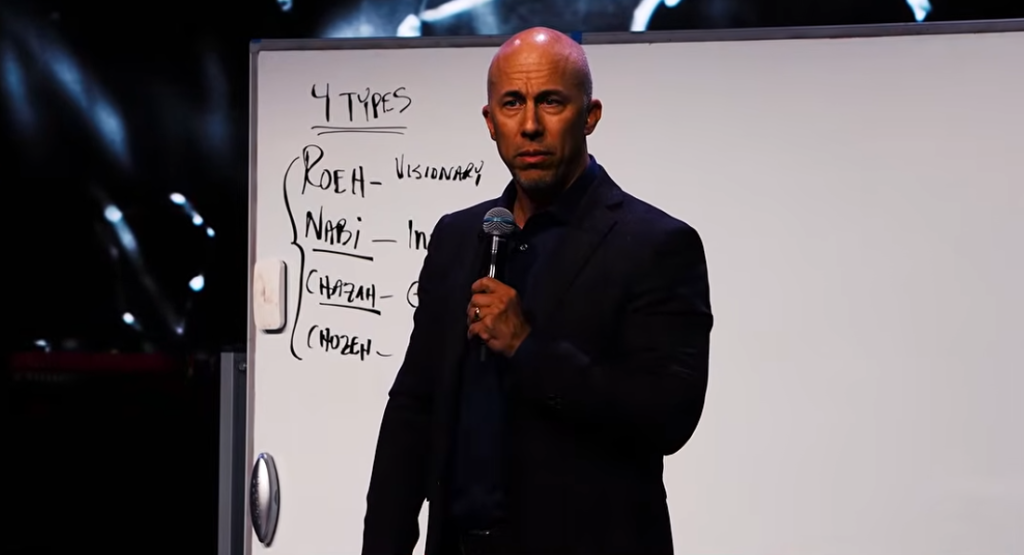
There are four basic flows of prophetic ministry, and the words come from the Hebrew language. The first is Roeh, the visionary. Someone who operates in this spectrum operates from a gut instinct, a heuristic sense of where things are headed, and the ability to rally people around it. Many CEOs and leaders of organizations move in this gift; it mobilizes a group and says, “This is the direction to walk in.”
The second is Navi, a bubbling-up, on-the-spot inspiration. It is the preacher who studies all night for one message, then stands up and says that the Lord changed it, and gives an entirely different word instead. It works the same way in a word of knowledge delivered on the spot, in the middle of a conversation or a meeting.
The third is Chazah, to gaze, to look intently until information comes. The fourth, and the rarer one, is Chozeh, to peer, a posture of leaning forward into the distance. This is where trances and visions happen, where a person is caught away and does not know whether they were in the body or out of it.
These four types of prophecy are guidelines, not hard walls, and the Lord moves through all of them, sometimes blending two in the same person. In most meetings, Navi carries the bulk of it, with people getting inspired and declaring something in the moment. Chazah tends to show up in personal ministry, gazing at one person and receiving a specific word of knowledge for them. Chozeh is the rarest of the four, and it is not something to look for.
A Chozeh moment came on a live broadcast years ago. In the vision, a smoke plume rose off an island in the sea, and it was not clear whether it was a bomb or a volcanic eruption. The moment was declared on air, and the live audience prayed. Two days later, a Tonga island chain volcano erupted, an explosion visible from space. The Lord gives forewarning so that people can pray and lives can be spared.
Another Chozeh moment came at the Brownsville Revival in 1996. At the end of the week, I was walking across a parking lot toward a bus, and was soaked in the presence of God. When I was on the bus, suddenly, I was standing somewhere else, a landscape where everything—the ground, the trees, and the whole horizon—was made of concrete. A small white seed sat in my hand. A Voice told me to throw it, and when I did, it struck the ground and exploded, leaving a crater as dirt and rock flew upward. Then came the words, “So shall your words be to the hearts of men.” The next moment, I was back on the bus. That is Chozeh: a trance, a vision, being caught away, the same category as Peter’s vision on the rooftop (see Acts 10:9-16).
When Two True Prophets Disagree
In 2020, a genuine rift opened in the prophetic community. Many, going back to 2015, prophesied that Donald Trump would win both in 2016 and again in 2020. At Trump Tower in 2015, I was told plainly that I had not been graced to know the outcome of the election, only to pray for Donald Trump, and that America had one more round because the young lions were coming. They would be a generation that would rise in the military, education, the church, and government.
When the 2020 election came, the prophetic community split into confusion. On one side, there was an echo chamber of certainty that Trump would win because they had prophesied that he would win in 2016. It was a foregone conclusion to them. On the other side, almost no one dared say he could lose.
However, before the 2020 election, I had two dreams that showed the opposite of what much of the prophetic community was declaring. The dreams depicted the public perception of Trump losing brought about by technology rather than the will of the people. I spoke that word at a real personal cost.
Around that same time, a Voice came to me in a room and said it had come from the throne of God, that I was not needed yet, but I should prepare because I would be needed after the 2020 election.
Timing in prophecy matters as much as accuracy. In Genesis 37:5-11, Joseph received a genuine revelation about his own future and said it out loud too soon, telling his brothers he had seen them bowing down to him. The dream itself was accurate. The timing for announcing it was not, and it cost him years in a pit and in slavery before the same word came to pass on God’s timeline rather than his own.
Here is the resolution, and it reframes the whole controversy. There is another example of contradicting prophecies in the Old Testament. It was between two prophets, Ezekiel and Jeremiah, who spoke to King Zedekiah about the same coming disaster and seemed to flatly contradict each other. Ezekiel told him:
I will also spread My net over him, and he shall be caught in My snare. I will bring him to Babylon, to the land of the Chaldeans; yet he shall not see it, though he shall die there.
—Ezekiel 12:13
Jeremiah told him the opposite.
And Zedekiah king of Judah shall not escape from the hand of the Chaldeans, but shall surely be delivered into the hand of the king of Babylon, and shall speak with him face to face, and see him eye to eye.
—Jeremiah 32:4
Ezekiel said Zedekiah would not see Babylon, and Jeremiah said he would look the king of Babylon in the eye. When Babylon invaded, Zedekiah was captured, his eyes were put out, and he was led to Babylon, where he died. Both prophets were correct. He saw the king of Babylon eye to eye before he was blinded, and he never once saw the city he was led into afterward. The revelation was accurate on both sides.
The framework behind interpreting a Word from God is revelation, interpretation, and application. Going straight from revelation to application is where confusion and inconsistency starts. A revelatory moment can be completely real and still need to be walked through rather than declared as already complete. Psychology has a similar principle: The map is not the territory. Something can be seen accurately and still look different once it actually plays out, similar in shape but not identical in detail. The right response is to read the terrain as it unfolds rather than force the moment to match the original picture exactly. What many people miss is the interpretation and the application. This part of prophetic ministry keeps a true word from being read like a flat math equation with no depth perception.
New Testament Prophecy
The New Testament changed how the gifts are judged. The Old Testament ran on power steering: a prophet said exactly what he was told, or it cost him his life. Acts 15 shows the shift. When Gentile believers came into the church, the apostles did not ask them to keep the whole law. They asked them to abstain from sexual immorality and food offered to idols (see Acts 15:29 KJV). The standard changed because Jesus fulfilled the law (see Matthew 5:17).
That is why a prophetic word can be almost entirely accurate and still require interpretation. For example, Agabus prophesied that Paul would be bound by the Jews (see Acts 21:10-11). In the end, Paul was bound by the Romans, not the Jews directly (see Acts 21:31-33), yet Agabus was never called a false prophet. The word needed interpreting, not a flat, line-by-line accounting.
Office, Gifting, and the Gray Area
Having a prophetic gift is not the same as being in the office of the prophet. A person can move powerfully in a spiritual gift, through hunger and practice, without operating in the office of the prophet. Paul made the distinction himself.
If I am not an apostle to others, yet doubtless I am to you.
—1 Corinthians 9:2
An office carries responsibility for a particular group of people; the gift itself is simply a function available to any believer. Ephesians spells out the reason for both.
And He Himself gave some to be apostles, some prophets, some evangelists, and some pastors and teachers, 12for the equipping of the saints for the work of ministry, for the edifying of the body of Christ,
—Ephesians 4:11-12
The question an office gift answers is simple: Who are you responsible for, and who has recognized it? A title claimed without an answer to that question usually does not hold up. In one meeting, a man sat convinced in his own mind that he carried the office of apostle. The Lord told me to tell him plainly that he did not, and to bless him anyway. As it relates to the prophetic, being correct about having a gift to prophesy does not settle the question of whether you are in the office, because any believer could be given the gift of prophecy (see 1 Corinthians 12:7-11). Only accountability to a body of people puts you in the office of the prophet.
Scripture lays out ways a genuine call gets confirmed rather than simply self-declared. It is through another minister’s recognition, through the Word of God bearing witness, through the visible fruit of the work, and through the Voice of God directly to the person (see John 5:31-37). A title that has not been recognized through any of those channels is usually a title someone gave themselves.
There are also consistent marks that separate real gifting from the false. The gift itself is not one of them, because a false prophet can still carry it and even deliver an accurate word of knowledge. However, what separates them is character and intent.
The real prophet is built on the Word of God, peer accountability, integrity, honesty, and generosity. The false leans toward greed, being unteachable, and false humility that is harder to work with than open pride, because at least pride shows its hand. Genuine prophetic ministry runs alongside radical generosity; a stingy hand and a strong prophetic gift do not travel together for long, and a person who cannot give freely rarely carries much lasting power in the gift.
The gray area sits outside both categories. It is not the correctable error of a novice who simply needs training. It is a soul that has never been separated from spirit-chasing impressions and never added the discipline of Scripture to catch what began as authentic gifting. A novice is confused and correctable; a false prophet knows exactly what he is doing.
Read the word until it talks back, and gifting moves toward greater strength. If you leave the Word out, the same gifting drifts toward the gray area, and further still, toward real deception. A person may still be pulled back with a rebuke while they are partway down the road of becoming a false prophet. If they are further along, the pattern hardens.
The safeguard through all of it is the same one Hebrews gives:
That you do not become sluggish, but imitate those who through faith and patience inherit the promises.
—Hebrews 6:12
For Jesus,
Joseph Z
Click here to watch the full video.